

Technical information
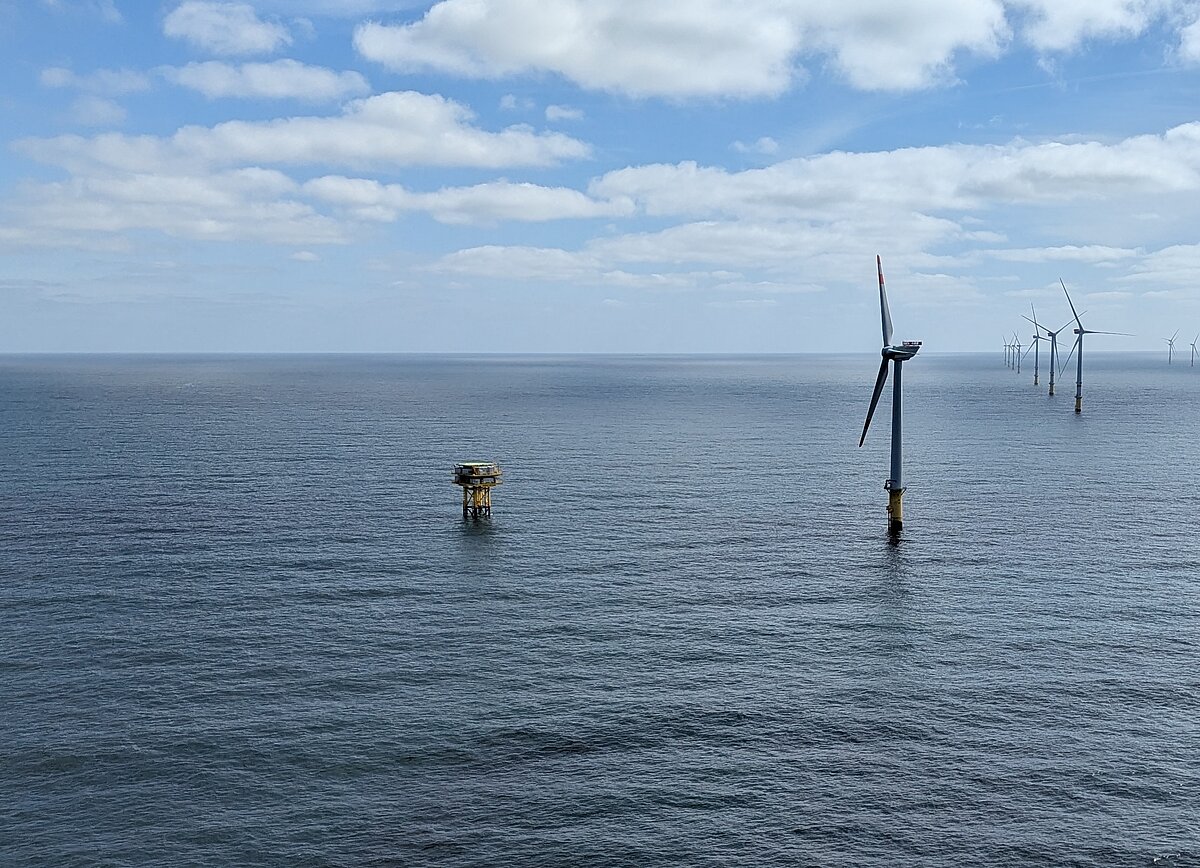
Twelve wind turbines and an offshore substation make up the alpha ventus wind farm in the German Bight. Originally known as the ‘Borkum West Test Field’, the wind farm was designed to provide a basis of experience for further offshore projects in Germany. For this reason, there are also a number of technical features that set alpha ventus apart. One striking feature is that six of the twelve wind turbines are of different designs and stand on different foundations – making it Germany’s first offshore wind test site.
What the turbines have in common is a rated output of 5 megawatts each – at the time of construction, the highest output available on the market for offshore wind turbines. Nevertheless, at that time, most offshore wind farms were planned on average with ‘smaller’ offshore wind turbines starting at 3.6 megawatts, and it was not until 2012 that 5 megawatts became the norm. Ultimately, it comes down to cost-effectiveness: is it cheaper to install and operate several small turbines or a fewer, larger ones? This can vary considerably from site to site. Today, newly installed offshore wind turbines are in the 15-megawatt power class.
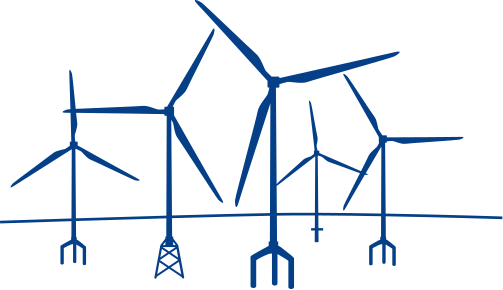
AREVA Multibrid (or Multibrid) supplied six turbines (type M5000-116), whilst six turbines (type 5M) were supplied by Senvion (formerly REpower Systems). In terms of external dimensions, the turbines are quite comparable – but their internal technical workings differ significantly. Both types of wind turbine tackle the challenges of the site in very different ways: aggressive sea air, high wind speeds and limited accessibility. The manufacturers also employ different concepts for the foundations: Multibrid’s WECs are mounted on tripods, whilst Senvion’s are mounted on slightly lighter, four-legged lattice masts, known as ‘jackets’. The type of tripod used at alpha ventus has proved susceptible to scouring. This problem was resolved for alpha ventus by retrofitting scour protection.
At the heart of alpha ventus lies the offshore substation – a fully equipped transformer platform on the high seas. This is where all the cables from the wind turbines converge, and the electricity, which arrives at a voltage of 30 kV, is stepped up to 110 kV to minimise electrical losses during transmission to the mainland. The alpha ventus subsea cable runs via the island of Norderney and reaches the mainland at the Hagermarsch landing and feed-in point. The cable route laid for alpha ventus now serves as one of the routes for climate-friendly electricity from the North Sea into the German transmission grid.
Technical data
| Area | 4 sqare kilometre | |
|---|---|---|
| Water depth | up to 30 metre | |
| Rated output | 60 megawatt | |
| Start of construction | 2008 | |
| First power input | 2009 | |
| Commissioning | 2010 | |
| Turbines | 6x SENVION 5M | 6x Multibrid M5000-116 |
| Foundation | Jacket | Tripod |
| Rotor diameter | 126 metre | 116 metre |
| Hub height | 92 metre | 90 metre |
| Total height | 155 metre | 148 metre |
| Total power | 30 megawatt | 30 megawatt |
Technical information converter platform alpha ventus
| 30 metre | Helikopter deck |
| 25 metre | Main Deck |
| 21 metre | Cable deck |
| Cable deck and main deck | 110/30 kV Transformator 75 MVA (AREVA) |
| Jacket Height | approx. 46 m |
| Jacket Mass | approx. 650 t |
| Fondation Piles | Length 30 m, diameter 2,7 m, weight 100 t per pile |
| Position | N 54°00', E 6°37.40' (in Google Maps öffnen) |